Cleaning never ends
Bath mats, carpets, corners, and bedding become part of the daily routine. You are cleaning the symptom without knowing what keeps causing it.
A calm, practical guide to help you work out what to do next, make the setup easier to use, and know when the right next step is a vet call.

One-time payment · Read it on your phone · No subscription
Bath mats, carpets, corners, and bedding become part of the daily routine. You are cleaning the symptom without knowing what keeps causing it.
Use more boxes. Change the litter. Move the box. Try a diffuser. The advice piles up, but your cat still has a problem.
Some house-soiling changes need veterinary attention. A useful guide should help you spot that boundary instead of calling everything bad behavior.

Simple visual cues help you pause before treating a sudden change as a behavior problem.

Use practical setup ideas for apartments, shared rooms, and homes with more than one cat.
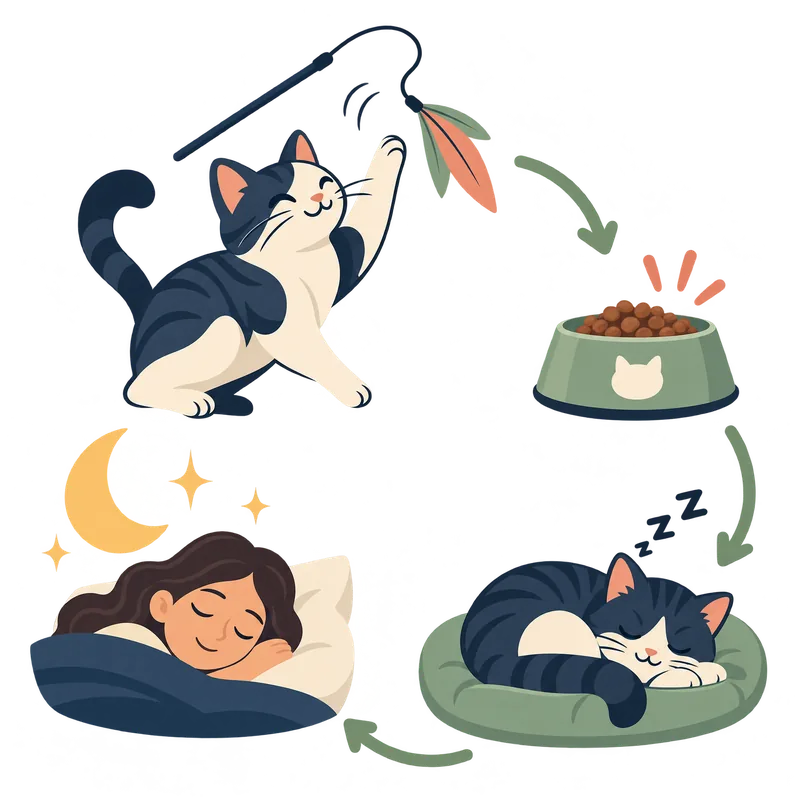
Turn the guide into small, repeatable steps that support both your cat and your household.
This guide helps you observe the pattern, check the urgent signs, adjust the setup, and stop guessing. It is written for everyday cat owners, including people working with limited space, time, or budget.
See which changes need a veterinarian before you treat the problem as a setup issue.
Work through location, size, access, litter, cleaning, and multi-cat resource choices.
Use the phone-friendly tracker to record the pattern and choose one change at a time.
Understand comfort, stress, fear, pain cues, and the moments when your cat needs space.
Answer a few practical questions and see whether your next step is a vet visit, a setup change, or both.
Options for box placement, access, cleaning, and resource separation when three boxes are not realistic.
Track time, location, triggers, eating, movement, and elimination changes from your phone.
Learn the difference between comfort, play, hunger, fear, overstimulation, stress, and a change from baseline.
Use plain-language steps for litter, box access, cleaning, and gradual changes.
Know what to record for your veterinarian and when straining with little or no urine needs immediate care.
Behavior can change because of pain, urinary disease, mobility problems, stress, or changes at home. The guide helps you observe and organize what is happening. It does not replace a veterinarian.
If your cat is repeatedly straining and producing little or no urine, treat it as an emergency and contact a veterinarian immediately.
Read the veterinary source ↗Sudden, painful, persistent, or unusual changes deserve professional attention.
Look for the signs that change the plan.
Use the setup and behavior details that fit your home.
Keep useful notes instead of trying random fixes.
Get the complete digital guide for $47. Read it on your phone, use the decision paths as you go, and keep the observation tools close when you need them.
Secure checkout via Whop. One payment, no subscription.
No. It is educational behavior guidance. It includes clear reasons to contact a veterinarian, but it does not diagnose or treat a medical condition.
Yes. The guide includes practical choices for limited space and explains how to work with the home you actually have.
The core guide is designed to be read in about an hour. You can then use the observation tools over the following days.
Repeated straining with little or no urine can be an emergency. Contact a veterinarian immediately rather than relying on a behavior guide.
It is a digital guide designed for phone reading, with decision paths, checklists, and a digital observation tool.
Get the guide, check the red flags, and work from the pattern in your own home.
Get the guide for $47 ↗One-time payment · No subscription · Digital delivery